- The court treats Mandatory Provident Fund (MPF) and pension savings built up during the marriage as part of the shared property, and your spouse may be entitled to a share by law.
- MPF splitting is not automatic. The divorcing spouse must apply to the court, and the whole process takes about three to six months.
- A separation agreement can set out how the MPF is split, but if either side did not fully disclose their finances at the time, the court can still adjust it.
- Divorce is not a reason to withdraw your MPF early. After divorce, update the named beneficiaries on your MPF and pension schemes.
Hong Kong’s divorce system aims for fairness and balance. MPF in divorce and pensions are an important part of dividing property, and homemakers, employees and self-employed people should all know where they stand.
How does the Family Court work? Marriage and divorce in Hong Kong today
In Hong Kong, all divorce cases are heard in the Family Court. The judge decides whether the divorce is granted and also rules on the related matters that follow.
Divorce is more than the end of a relationship. It is a rebuilding of daily life, and the Family Court is where the key decisions on the children, maintenance and the division of property are settled.
The Family Court handles nearly 10,000 divorce cases a year. Because the caseload is so heavy, the court encourages couples to try family mediation:
- With the help of a neutral third party, you can reach an agreement on property and arrangements for the children without going to court.
- A mediated agreement is not compulsory, but if it is fair and reasonable the court will usually respect and confirm it.
- Mediation saves time and money and lowers conflict. When MPF and pensions are involved, it helps you deal with complicated finances in a calmer way.
Over the past decade or so, the number of new marriages in Hong Kong has kept falling. Around the pandemic, marriage registrations dropped from nearly 50,000 couples a year to just over 20,000, while divorce numbers changed much less.
| Recent figures | |
|---|---|
| Crude marriage rate | Only about 4.5 per 1,000 people |
| Crude divorce rate | About 1.9 |
In other words, roughly 1 in every 2.4 married couples ends up divorcing.
High property prices, long working hours, job pressure and tight finances are the strains most often named in modern marriages.
Not sure what financial arrangements a divorce involves?
Get in touch, and a dedicated consultant will first understand your situation.

Preparing before divorce: what to remember about the children, the MPF and pensions
Many people’s first reaction when preparing for divorce is “I just want the pain to end quickly”. A more rational approach is to get three things ready once your emotions have settled:
-
Look after yourself emotionally
Divorce is a major turning point in life. We suggest seeking professional counselling, talking to friends or joining a support group to ease loneliness and anxiety.
-
Take stock of your finances
Gather your personal and joint bank accounts, property documents, investment reports, MPF account balances and pension schemes. Build a complete list of your finances so you know what counts as shared property.
-
Understand the legal process
If property or arrangements for the children are involved, the process can still be long and costly. Take a solicitor’s advice early, for example on whether a separation agreement suits you and whether to apply for an MPF splitting order.
If there are children, the Family Court puts the “best interests of the child” first. The judge cares most about whether the child will have a stable home and financial support.
Even after divorce, both parents must share the cost of child maintenance and education, and should communicate calmly to set up access and support arrangements that work in practice.
Please note
- When people divorce, the first things they think of are often the “property” or “savings”, and they overlook the MPF and pensions. For an employee who has worked for many years, the sum built up over decades can come close to the value of a flat.
- The court treats Mandatory Provident Fund (MPF) and pension savings built up during the marriage as part of the shared property, and your spouse may be entitled to a share by law.
- This kind of division is not automatic. The divorcing spouse must apply to the court for an “ancillary relief order” to ask for the MPF to be split.

- Dividing Hong Kong insurance policies when property is divided after divorce
- Changing the name on a flat, divorce mortgages and property title transfers explained
- Risks of moving assets before a divorce, and how to avoid having property divided
Your future safeguard: a separation agreement and MPF planning before divorce
In Hong Kong, many couples planning to divorce sign a “separation agreement” before they file. It sets out each side’s rights, duties and financial responsibilities while they “live apart”.
The greatest value of a separation agreement is that it turns an “emotional problem” into “concrete arrangements”.
The court does not require this agreement, but if you both write the terms calmly and in good faith, you cut the risk of disputes later.
Why the “MPF” and “pensions” belong in a separation agreement
- When most people sign a separation agreement, they focus on concrete assets such as the home, bank accounts and cars. The MPF and pensions are the easiest to overlook, because they are “hidden assets”.
- On divorce the court can make an “ancillary relief order” directing the trustee to transfer part of one spouse’s MPF to the other, but a request must be made in the divorce proceedings before the court will consider it.
- If the separation agreement already records that you both agree to this, it gives the court a guide when the divorce comes and saves a lot of argument.
- If the agreement says nothing, the other side can still apply if their spouse refuses to cooperate, but the process takes longer and costs more. They might even forget to apply once the divorce is finished and lose the right.
For example, the agreement could say: “When applying for divorce, both parties agree that their solicitors will apply to the court for an MPF splitting order. The split will be 50% of the part built up during the marriage.”
In practice, “the MPF built up during the marriage” is what the court focuses on.
Only the part built up from employer and employee contributions between the date of marriage registration and the date of formal separation or living apart can count as part of the marital property.
| Example | |
|---|---|
| Husband starts work | 2005 |
| Marriage | 2010 |
| MPF balance before marriage | HK$300,000 |
| Total balance at divorce in 2025 | HK$1.5 million |
| Amount built up during the marriage | HK$1.2 million (HK$1.5 million less the HK$300,000 from before the marriage) |
| Wife’s share at a 50% split | HK$600,000 |
The court usually starts from this HK$1.2 million and then decides the split.
Investment returns also count as part of what has built up. If the MPF investments did well during the marriage, the growth is counted as “shared property” too.

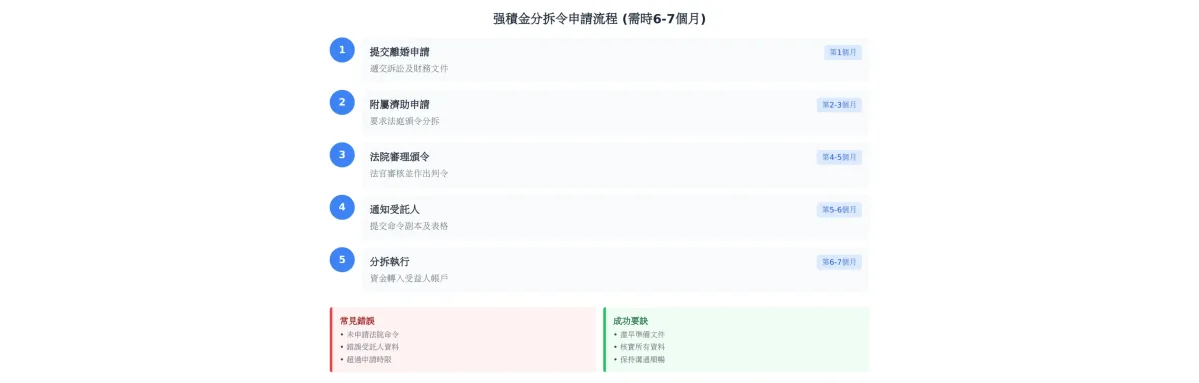
MPF splitting is not automatic. One spouse (or both) must apply to the court. The usual steps are:
-
Filing the divorce application
Both sides file their financial details (such as Form E) and a full list of assets. You must state truthfully your MPF contributions, the trustee’s name and the current balance.
-
Make an “ancillary relief application”
One spouse can apply within the divorce proceedings, asking the court for a property order. An MPF splitting order is one of these.
-
Court review and order
The judge looks at both sides’ finances and how the assets are spread, and decides whether to split the MPF and in what proportion. If approved, MPF splitting terms are attached to the divorce order.
-
Notify the MPF trustee
The solicitor for the receiving spouse (called the “beneficiary”) must send the original contributor’s trustee a copy of the court order and the specified form.
-
MPF account adjustment
Once the trustee receives the order, the corresponding share is normally moved within about eight weeks into the beneficiary’s “MPF allocation account”. It still cannot be withdrawn before retirement age.
The whole process takes about three to six months, depending on how quickly the court and the trustee work.
Splitting ratios in practice, and pensions beyond the MPF
The court generally follows the principle of “fair distribution” rather than a mechanical 50/50 split. The factors it considers include:
- Length of marriage: after a short marriage (for example under five years) only a lower share may be split, while after a long marriage the share is close to half or higher.
- Income gap: if one spouse has had no income for years and has contributed mainly by looking after the family, the court tends to give a higher share.
- Future needs: a spouse who is older or in poor health may also receive a larger share.
The judge’s guiding idea is “fairness and securing the future”. MPF division looks back at past contributions and also asks whether each side can meet basic living costs and have a secure retirement after the divorce.
Many Hong Kong employers (especially in the public sector or large organisations) still run “occupational retirement schemes”, which fall into two types:
| Features | |
|---|---|
| Defined contribution scheme | Similar to the MPF, with an actual balance you can check |
| Defined benefit scheme | The future payout is worked out from years of service and final salary |
For a defined benefit scheme, the court asks an actuary for a valuation report to put a figure on its present financial value.
If a spouse has already retired and is drawing a pension, the unwithdrawn balance in the account or the monthly pension cheque is an asset that can actually be used, and goes straight into the pool of property to be shared.
How to word pension terms in a separation agreement
- When an experienced solicitor drafts a separation agreement, they will usually suggest adding: “The parties agree that, for the MPF and pension entitlements built up during the marriage, a proposed split will be set on fair principles, and the court will then make an ancillary relief order according to the actual circumstances.”
- Wording like this keeps your flexibility to apply to the court later, and avoids legal limits if either side’s finances change.
- If the agreement fixes a specific ratio (such as 50%), that helps enforcement later. But if either side did not fully disclose their finances at the time, the court can still adjust it. An agreement made in advance does not guarantee the final result.
Details such as the trustee, contribution dates and current balance can be requested from your employer or trustee at any time. Here is a suggested checklist:
- MPF statements for the last 12 months
- Trustee details (company name, scheme number, contact details)
- Date of first contribution and amount built up
- Date of marriage registration and date of formal separation
- If you have had several jobs, a list of each MPF scheme
If you gather these documents early, you save a great deal of time and solicitor’s fees when you reach the stage of filing with the court.
Treat your MPF as part of your “future self”. The MPF and pensions are not assets you can see right away, but they are the safety net for your later years.

How is the split considered if the ratio is not settled?
Feel free to check your situation with us.
Principles for dividing property on divorce in Hong Kong: MPF and pensions in practice
Under the Matrimonial Proceedings and Property Ordinance (Cap. 192), the court works on “fairness and reasonableness” and treats the property both spouses built up during the marriage as shared assets to be divided.
“Division of property” is often the most contested part of a divorce. It covers cash, real estate, investments, company shares and pensions, and of course the MPF.
The court does not simply divide property in half. It weighs several factors together, including:
- Length of marriage: the longer the marriage, the more readily property is seen as the “result of joint effort”. For marriages of over twenty years, an equal split is common.
- Gap in earning power: if one spouse has a steady income and the other has long depended on them, the court tends to give the lower earner a higher share.
- Future needs: a spouse who is older, in poor health or raising the children will usually receive more protection.
- Non-financial contributions to the family: unpaid work such as looking after the home and raising the children is also taken into account.
Even if a spouse is a full-time homemaker with no earned income, the court still treats their contribution to the marriage as an “indirect financial contribution”, and they have a legal right to share in the property.
When dividing property, a Family Court judge does not look at “who earns more”. The judge looks at “who needs protection” and “who gave what”.
The MPF is the “hidden asset” that comes up most often in Hong Kong divorce cases. Unless the court orders otherwise, neither spouse may use it early or transfer it.
If you want a share of your spouse’s MPF, the only lawful way is to apply for an “MPF splitting order”. The Family Court must make this order, and the trustee carries it out.
Three key points about MPF splitting:
- Only the part built up during the marriage: contributions before the marriage or after the divorce are not divided.
- The court decides the ratio at its discretion, commonly 50%, 40% or 60%.
- The split amount goes straight into the beneficiary’s MPF allocation account and cannot be withdrawn early.
Please note
- If the MPF split is not applied for before the divorce order, it generally cannot be added afterwards, even once judgment has been given, unless the judge gives special permission.
- This is why solicitors usually advise raising it at the very start.
MPF built up before the marriage is not counted as shared property, unless there is clear evidence that the pre-marriage part was treated as being for the family’s use.
| Example | |
|---|---|
| Already in the MPF account before the marriage | HK$500,000 |
| From marriage to divorce | Grows to HK$1.5 million |
| Part the court divides | The HK$1 million increase in between (including interest and gains) |
If the pre-marriage amount cannot be clearly separated out, the judge may work it out by proportion over the whole balance, so it is very important to keep early contribution records and MPF statements.
Some employees of large companies and public bodies belong to an “occupational retirement scheme”. On divorce, the court treats it together with the MPF as a marital asset and works from the combined value.
If the pension has not yet been paid out, the judge can ask an actuary to estimate its present value (a discount rate of about 3% to 4% is common), and solicitors often commission a “pension valuation expert report” as evidence.
Suppose the marriage has lasted 15 years, the wife stays at home with the children and has no income, the husband earns HK$80,000 a month, his MPF balance is HK$1.8 million, and the flat is registered in his name and not yet fully paid off. The court might make the following arrangements:
- The wife receives a 40% share of the flat’s sale price;
- she also receives 50% of the part of the husband’s MPF built up during the marriage;
- the husband keeps the remaining assets and continues to pay child maintenance.
This “layered fairness” is a common approach for the court. The aim is to make sure both sides can still keep a reasonable standard of living after the divorce.
Once an MPF splitting order is made, it stays binding even if the contributor later changes jobs, changes trustee or even retires early.
Please note
- If the trustee was changed before the divorce order, the party must give the court order to the new trustee. If you forget to notify them, the split may be delayed or may not be carried out at all.
- Retiring early does not mean you can take out your MPF whenever you like, unless a statutory condition is met (for example reaching age 60, leaving Hong Kong permanently, or total incapacity).
- If a spouse hides assets or refuses to provide MPF statements, formal court proceedings are needed. The court can order that spouse to give full disclosure, and refusing or giving false information may be treated as contempt of court.
- Hiding MPF assets is dishonest conduct of a criminal nature. Once the court finds out, it will redistribute the assets and penalise the party in breach.
In disputes over the MPF and pensions, solicitors usually advise trying family mediation first, to avoid expensive litigation costs and bitter conflict.
According to information from the Mandatory Provident Fund Schemes Authority and the Law Society, the mistakes people make most often include:
- Assuming the MPF can be split without a court order. MPF companies do not recognise verbal agreements or a divorce certificate.
- Getting the trustee or account number wrong. You must confirm the exact company and scheme name.
- Applying late. If the application comes after the time limit following the divorce order (generally three months), it may be refused.
- Not providing proof of the pre-marriage balance, so the court miscalculates the part built up.
The MPF is the “hidden shared asset” of a marriage. Most Hong Kong people think of it as money they can only use after retirement.
But in a divorce, it is one of the most valuable assets and also one of the easiest to overlook.

Maintenance after divorce, digital assets and managing the MPF afterwards
A divorce order only ends the legal marriage. Maintenance after divorce and managing the MPF afterwards are both key to rebuilding your life.
The Family Court’s goal is not to make one side “win”. It is to let both sides lead calm, stable lives after the divorce.
Under the Matrimonial Proceedings and Property Ordinance (Cap. 192) and related Family Court decisions, maintenance in Hong Kong falls into two kinds:
| Purpose | |
|---|---|
| Spousal maintenance | Helps the financially weaker spouse keep a reasonable standard of living for a period after the divorce |
| Child maintenance | Pays for necessary costs such as the child’s education, medical care, food and clothing |
The court decides the amount and the length of time by looking at:
- Both sides’ income and assets
- Length of the marriage and standard of living
- The age, health and earning ability of the spouse receiving support
- Whether there are children to support
In general, if the marriage has lasted many years and the receiving spouse has long been out of work, the court may order long-term maintenance or a lump sum.
If both sides are in similar financial positions, the court may order small periodic payments, usually for a few years, so that the receiving spouse has time to readjust to work and daily life.
Even if the account balance is large, you cannot pay maintenance directly from the MPF. MPF law strictly limits when it can be withdrawn, unless one of the following applies:
- Reaching age 60, or retiring early at 55
- Leaving Hong Kong permanently
- Total incapacity for work
- Death (the assets pass to the beneficiary)
If the paying spouse has little cash flow but a large pension sitting in the MPF, the court cannot order it to be used immediately. The usual solutions are:
- Paying with other assets or in cash instead;
- Combining this with an MPF splitting arrangement, so the financially weaker spouse receives their share directly and relies less on maintenance later.

Once the divorce order takes effect and the property has been divided, you should deal with your MPF accounts straight away:
-
Check the split has been carried out
Ask the MPF trustee whether the split has been carried out and whether the right amount has gone into the “MPF allocation account”. Also confirm how to log in and which investment funds are chosen.
-
Update your personal details and beneficiaries
If your ex-spouse is still your “named beneficiary” after the divorce, they may still be entitled to receive your benefits if you die. Update this with all your MPF and pension schemes.
-
Review your retirement plan
If your investment strategy was based on “living together”, reassess your risk appetite and contribution amount. If maintenance or the split has reduced your assets, consider contributing more or retiring later.
Digital assets must be disclosed in a divorce, and the court will count them at market value when dividing property. Examples include:
- Cryptocurrency
- Online investment accounts (such as eToro and Interactive Brokers)
- Virtual property or NFT
- Shares in online companies and income from intellectual property
Unless the court orders a “clean break” lump sum, if maintenance was being paid monthly and either side’s income rises or falls significantly, both sides can apply to vary the order (Variation of Order).
For example, if the receiving spouse later makes a large gain on cryptocurrency, the court can apply the “principle of fairness” to reduce the other side’s obligation, and the reverse also applies.
The myth about withdrawing MPF early after divorce
- Divorce is not a reason to withdraw early. MPF received through a split is managed under the same rules as the original account, and you must wait until the statutory age to take it.
- If you plan to emigrate or leave Hong Kong permanently after the divorce, you can make a “permanent departure claim” to the MPFA and provide proof of departure (such as a visa or a residence permit abroad). Only after the trustee receives approval can the full balance be lawfully released.
Under the Mandatory Provident Fund Schemes Ordinance (Cap. 485), a named beneficiary is not updated automatically by marriage or divorce unless you change it in writing. After you remarry, we suggest you do the following straight away:
- Check the beneficiary list of every retirement scheme;
- Update your will to match;
- Make sure new family members are properly protected, legally and financially.
Living costs in Hong Kong are high, so we suggest building a “financial self-protection plan” for after the divorce, using these strategies:
- Set up a separate savings account: avoid mixing money with your ex-spouse or in joint accounts, so your finances stay clear.
- Monitor your MPF: log in to the MPFA platform or the trustee’s website regularly to track investment performance.
- Buy personal insurance: medical, accident and life cover, to fill the gaps in protection left after the marriage.
- Get professional financial advice: on restructuring your retirement savings, tax and long-term investments.

- A guide to how Hong Kong maintenance is calculated, how long it lasts and when it stops
- How to secure the best maintenance after divorce
Not sure about maintenance arrangements after divorce?
If in doubt, feel free to contact our dedicated consultants.